Berkleigh Country Club

Berkleigh Country Club, one of the premier courses in southeast Pennsylvania, has always been on the edge.
The Lehigh Valley and the Schuylkill Valley in the United States are tied together by a thick ribbon of Germans and Eastern European peoples—many of whose families have lived there since the 1700s. Until very recently, well within the lifetime of this author, Jews living in this ribbon were regarded as undesirable riffraff, rough, grasping, uncouth, and uncivilized—not to mention Christ-killers.
And so, Jews were not allowed to play on the area golf courses.
Period.
But, by the 1920s, the children and grandchildren of the Jews who had immigrated to the US in the 1870s through the 1890s wanted to play golf. So, the Jewish population of Berks County and the Lehigh Valley undertook a subscription drive to build a course. They bought a farm—very far outside of town rather understandably—and began to form a club. By 1925 (probably in 1924), they had contracted with Robert White, the Professional Golfers Association’s (PGA) first president and a native of Scotland, to build what would be the first nine holes.
Anyone who has ever played the first nine holes of Berkleigh can immediately feel the Scottish influence. Although this is a parkland course, it is not a typical American parkland course at all. The spontaneity and naturalness of most Scottish courses are replicated here. Berkleigh’s first nine (described below) impose only enough order on the landscape to define a golf course; with the exception of the traps, the whole nine could have been built without any earth-moving equipment at all—OUT damned bulldozers.
The club prospered and added a back nine—a championship layout back nine, but one that was more designed by the rolling terrain than by a soulless architectural process. Particularly in its early holes, echoes of the Scottish heritage can still be heard. Despite the fact that it used to be a stop on the LPGA tour, it does not grab you by the shirt front and yell that is a “championship golf course.” Instead the course invites you in for a bit of smoked haddock stew, maybe some chips, has a draught with you, asks you about your family, and then invites you to play and ruin your handicap.
On the first nine, the second hole, fourth, and fifth holes particularly show the Scottish influences of naturalness and spontaneity. The tee shot on two, a par four, is a blind shot across a small ridge.
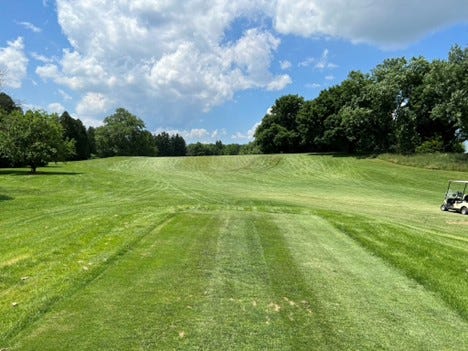
The ridge masks a small creeK, but assuming you miss the stream, the hole turns uphill to an elevated green and a somewhat off-camber green. A perfect shot into the green may not be where you land it, it may be where the second or third bounce takes it—a perfect links challenge.
The 412 yard par 4 fourth hole is a beauty and the number 1 handicap for men. Your drive will land either on this side or that side of a hillock masking a hole. And that hillock obscures the same “wee burn” that ran through two. From the many times I have played Berkleigh, I can testify that the hillock makes it difficult to actually locate the water—at least intentionally. Good shots have a way of disappearing into that “wee burn.”
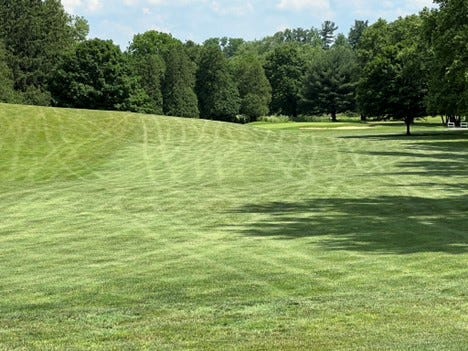
If four is a beauty, five is absolutely what a golf hole should be like. It starts with a bog, then climbs up a very steep hill, where it doglegs along the front edge of a ridge—a dogleg whose second leg slopes steeply to the left down to another watercourse. There is a safe route, which takes you down the right hand side and allows, if you reach the top of the hill, a player to hit from one flat section of the fairway to another. But the “safe route” increases your trip home by probably sixty yards. The last time I played this hole, I hit a long drive which had a slight draw at the end . . . and it probably hit the fairway slope and bounced way left into the creek. Since the landing for all but the right edge of the fairway is blind, I am never going to know where it went (at least on this side of the afterlife).

Unlike the other holes on the frontside, nine was clearly imposed on the terrain. But Robert White had run out of room on the farmland the nascent club had taken over. He had to end the course by creating a 317 yard hole (men’s distance). But he did so with a certain flair: seven sand traps, five blocking the green and two penal traps beside the green. The only safe shot coming into the green is to layup to the right edge of the fairway and try to fly your ball in from there. Otherwise you need a very high, soft shot to clear the bunker squarely in front of a difficult green while holding the green. Go left on this hole, by the way, and learn what the word “penal” means!

The thirteenth hole is another magnificent hole that blends nicely with the landscape. And it is tough. (The photo below is taken from the seniors’ tee area.) Unless you have had a recent injection of blood from Tiger or Brooks, you are not going to make that “little” ridge you see in the distance. You cannot see it from the tees, but there is a good size burn running along the right—to which the fairway slopes . . . and the grass in that area is always above your ankles, I have wondered if it is some foreign species grown by a hostile and totalitarian regime for the sole purpose of eating American golf balls.

The hole doglegs downhill to the right once you are over the ridge—a dogleg which, by the way, you cannot see when you hit your shot over it. Needless to say, your margin of error is just about zero on thirteen—it’s a great hole.

Fourteen is straight, (not long at 341 yards) sharply uphill and has a gentle slope to the right—right into woods. This is the #2 handicap hole on the course, and it requires two very good shots not only uphill, but in between two greenside bunkers that narrow your target considerably. The average score on fifteen is over double-bogey—which says about all you need to know regarding what this “straightforward” and “short” hole. The view from atop this ridge is superb, by the way.

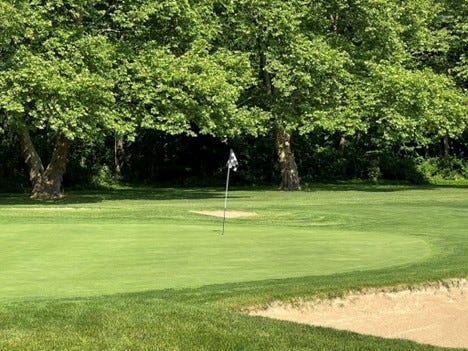
On sixteen you come off the ridge and up the side of yet another ridge—but sixteen is straightforward and actually one of the easier holes on the course. Seventeen looks easy when you are standing on the tee box, but the stream on the hole (another “wee burn”) is just about where tee shots long to go.

Eighteen is a marvelous finishing hole. More uphill than the picture shows. it is yet another one where the slope of the fairway turns it in a dogleg. Only 460-470 off the men’s tees, two good shots and it is a wedge or short iron into a green guarded by a lovely bunker that comes close to being a pot bunker. If you hit slices or pushes, you can become very familiar with the rough on the right and you definitely do not want to go toward the tree on the right. The shot in has to be hit “just so”—the green is a tilted bowl with high edges and a vicious slope.
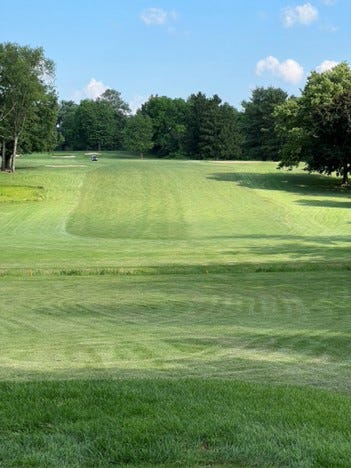
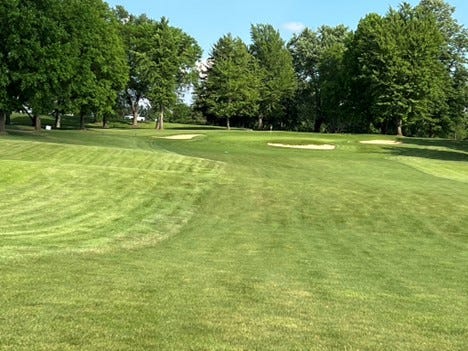
The bigotry of the old-time Germanic families pushed the Jews of the Schuylkill and Lehigh Valleys out, far out, into the countryside. That, however, allowed the Jews to build a course that was not constrained by the limits of more urban and more mainstream courses . Hewing to the land and softening the use of strict architectural protocols, it is challenging, but it is one of the more pleasant, and certainly one of the more beautiful, courses on the East Coast of the United States.
Its distance from everything, though, has made it difficult to sustain as a private facility and nowadays, it is public and tee times are easy to secure. It is definitely worth whatever drive you need to make to get there.